“We live well in this house,” says Marlene Degenaar with a satisfied look around her comfortable, canvas-covered wooden deck. This is one of her favourite parts of the home in Uitsig Estate in Nelspruit that she shares with her husband, Kobie, and their two meerkats.
Chiko is a friendly and inquisitive meerkat; Kiri is wary of strangers and chooses not to join us on the deck.
Chiko sniffs around our feet while Marlene gestures towards a lush bush garden that requires practically no maintenance. “This deck stays cool in summer, while our winter deck on the other side of the house catches the afternoon sun in the colder months and we often watch TV and braai there,” she says, with Chiko chattering appreciatively in the background.
The way the house is oriented and engineered makes the most of the natural attributes of the stand. Situated on a slope, it comprises interlinked modular units that hug the contours, granite outcrops and indigenous vegetation.
Designed by Nelspruit-based eco-architect Gavin Smitsdorp, the house is so well-integrated with the natural landscape it’s easy to drive right past it. “Effectively, the entire house is a series of pavilions suspended on platforms worked rigorously around the existing flora. Only one tree was damaged – not irreparably – during construction,” Gavin says.
With its grey exterior walls, you can’t see all the house from any one point, and almost nothing of it from the private road that passes behind it. “There is a bit of mystery about it,” says Marlene.
Once you’re inside, though, the house reveals itself fully, with clean lines that maximise light and landscape, views and thermal efficiencies.
The effect is visually stunning as well as practical. The entrance is informal, with a decked walkway that ramps and snakes towards the living area. There is a natural flow to the house that makes it comfortable to live in and easy to move around, as Chiko demonstrates by running in and out self-importantly as though he’s built the place himself. Kiri peers through the window from the opposite deck, curious about what’s going on.
Marlene has had Kiri for 11 years while Chiko is a more recent addition to the family. Both are rescue animals and they have the run of the house, “although we have to watch them with the snakes and birds of prey on the estate”, says Marlene.
Being close to nature is important to the Degenaars, who spend most of their leisure time in lowveld game reserves. Surrounded by buck, bush babies and squirrels on the estate, the couple are in their element. Marlene says the resident giraffes can browse at eye-level in some places due to the elevation of the house.
The house was originally built for Dr Stefanus Lombard, a prominent wildlife veterinarian and lecturer who has since moved to the Western Cape. “The brief was that he wanted a two-storey house for the views,” Gavin says. “I managed to convince him that the site was spectacular and we could achieve more if we studied it and exploited the gaps for views, thereby also avoiding exposure to the elements.”
Responding to the house’s architectural strengths, Kobie and Marlene knew this was the house for them the moment it came on to the market. “We like to keep things simple and practical and didn’t want a garden,” explains Marlene.
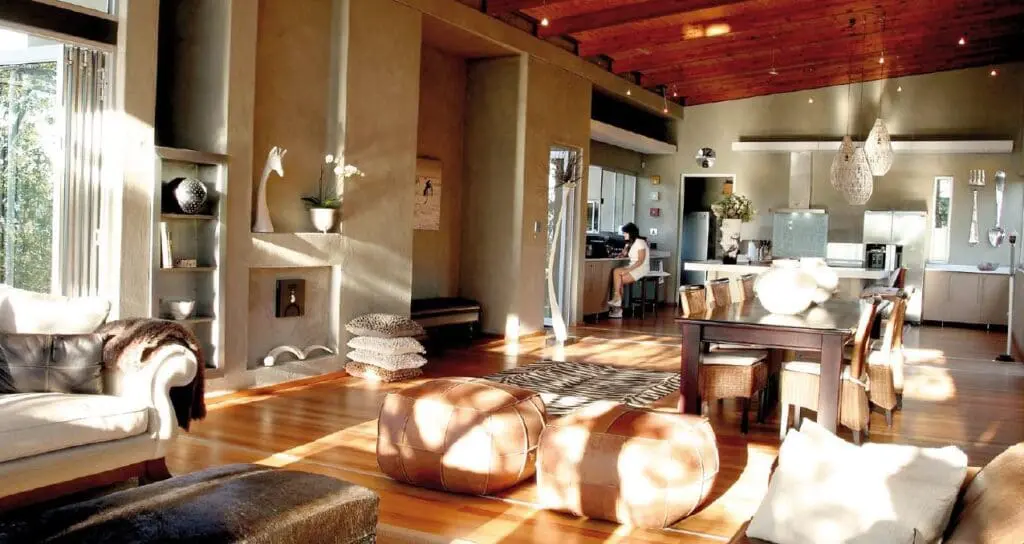
They began working on redecorating the house soon after buying the property. Chiko accompanies us on a tour of the interior to show off their handiwork.
The main living space at the centre of the home is a long, rectangular room with floor-to-ceiling windows. This room is bracketed at the top by a modern, symmetrical kitchen and at the bottom by a glass curtain wall – a structural brace that holds two five-metre, free-standing walls in place. It also perfectly frames a deciduous acacia tree that forms a focal point in the design.
Walls are painted in a cool slate grey, a unifying colour that runs through each room in the home. The warm lustre of wooden floors is repeated in the soft furnishings and is complemented by the vivid natural colours of the bush that grows up and around the house like a living nest.
Design elements such as the decks, the large windows, high ceilings and slatted wooden screens on the windows all contribute to airflow throughout the rooms, as well as maximising lighting and security.
Kobie, who runs an interior contracting business, brought his skills to bear during the interior renovation process, without sacrificing any of the structure’s balance and proportion. He introduced industrial blinds that are unobtrusively fitted to the large windows in the living room, extra-large stainless steel sinks in the kitchen and cleverly placed power points.
Marlene ensures that home comforts aren’t sacrificed in pursuit of the practical. Her touch is evident in a subtle palette of fine linens in each of the three beautifully appointed bedrooms, as well as cosy couches and other luxurious furnishings throughout the home.
Each aspect of the house articulates this mix of practicality and comfort within a spectacular natural setting. When Kobie starts to describe the things they still plan to do, he’s interrupted by an impatient Chiko. Whatever plans the Degenaars have for future, it is clear they will have to take into account their two furry tenants who rule the household.