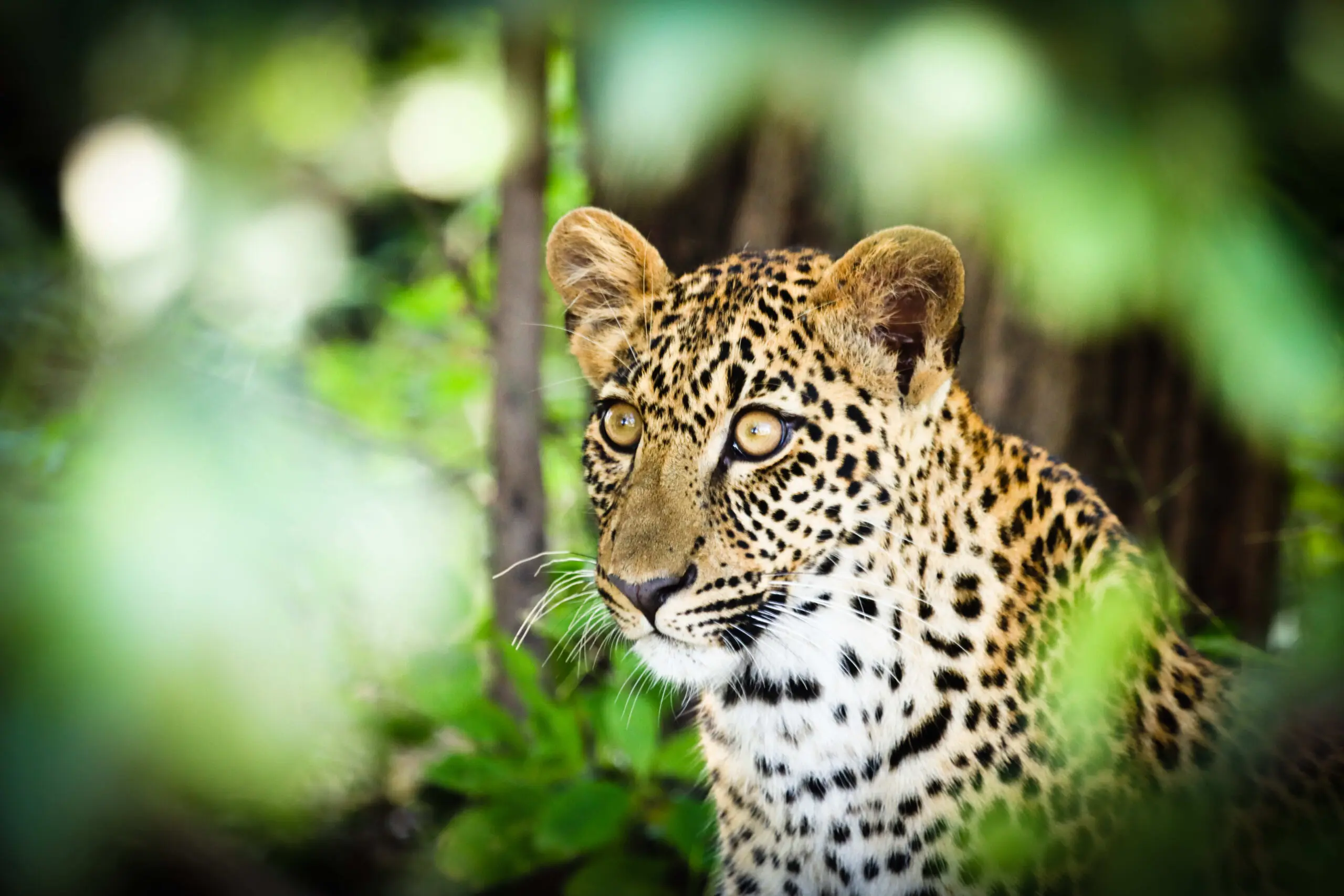
When researcher Kristoffer Everatt spotted a movement in the grass while conducting field work in Banhine National Park in Mozambique in July 2015, he wasn’t sure what it was. Stalking carefully towards the unknown animal, he finally parted the grass to stare into the eyes a beautiful black maned lion crouched about 4 meters away!
“We stared at each other for a few heart pounding seconds until I took the plunge and bluff charged him! He turned away and ran off growling his displeasure into the bush. He had just killed an aardvark and hadn’t yet begun to eat. I was so pleased to find him there, in south-western Banhine eating wild meat,” shared Everatt.
Everatt’s work in Banhine is part of the Limpopo Transfrontier Predator Project. The project is conducting ground-breaking research into the predator and prey dynamics in the Greater Limpopo Transfrontier Conservation Area to improve the conservation management of predator populations in this vast area. This is important for the regional and global viability of cheetahs, lions and African wild dogs because of population strongholds in South Africa’s Kruger National Park and Zimbabwe’s Gonarezhou National Park, which are contiguous to large tracts of potential habitat in Mozambique.
Banhine itself is in Mozambique’s northern Gaza Province. Proclaimed in 1973, it is a 7 000 square kilometres refuge for a number of wild life species. Along with Zinave and Limpopo national parks in Mozambique, Gonarezhou National Park in Zimbabwe and the Kruger National Park in South Africa, it is part of the Greater Limpopo Transfrontier Conservation Area (GLTFCA).
Finding this lion, and populations of cheetah and wild dog in Banhine National Park was a highlight for Everatt, who has been working in the area for 6 years. “These animals either represent pre-war relic sub-populations or the recent recolonization of lions from the Kruger-Limpopo system,” he notes. Genetics will hopefully answer this question definitively but either way, this find, “speaks to the importance of the developing Mozambican parks for the regional conservation of large predators”.


“There is a general negative and misguided perception about Limpopo National Park, and a complete lack of knowledge about it and the other parks in Mozambique. What we found in Banhine is truly exciting and demonstrates the importance of the area and need for conservation attention,” says Leah Andresen, who worked on the Limpopo Transfrontier Predator Project for 5 years. Affiliated to the Centre for African Conservation Ecology at the Nelson Mandela Metropolitan University, Everatt and Andresen are drawing on their work for their Phds.
During the course of their field work in Mozambican protected areas, they documented 49 mammal species, including bat-eared fox, aardwolf, African wild dog, serval, giraffe, zebra, roan, eland and sable. In Limpopo National Park specifically, they found 35 cheetah and 65 lions. Living close to rural villages, these predators are impacted by their proximity to people. Part of the project’s landscape level approach is to understand the dynamics between people, prey and predators. Current findings show that the Mozambicuan lion density is 1/3 of what it should be given the available habitat and prey, likely due to human persecution.
“We have the same needs as them and compete for the same resources in some landscapes,” notes Everatt. Usually though, it’s the lions that come off second-best. The lion that Everatt encountered in Bahnine, for example, was recently killed, along with a female and two cubs. They had attacked some cattle that were illegally free grazing in the national park. In retribution, all four lions were trapped and killed, with their body parts allegedly sold for muti.
As Everatt notes, “the killing of these four lions represents the loss of half of Banhine’s lions, as well as either some of the regions few remaining pre-war relics or the almost successful recolonization of lions in this historic range. Either way it is a tragic loss to Mozambique and to African lion conservation.”
As lions in particular come under increasing pressure in southern Africa, this project’s research has never been more important. “There has been an increase in the killing of lions in Mozambique,” confirms Kris. Additionally, the areas that make up significant parts of the GLTFCA are full of snares, “which are dangerous for species like wild dogs, which move into these areas in the absence of lions, falling into an ecological trap,” he explains.

Everatt is currently working to fit GPS collars on each of the established lion prides in the Mozambican component of the Greater Limpopo Lion Conservation Area. In the past weeks he has captured and collared lions from two prides. The data from the collars will allow conservation managers to target anti-poaching efforts directly into the home-ranges of these prides. The hope is that this will reduce the “unacceptably high levels of human caused mortalities in snares,” he notes. In addition the data will be used to determine the minimum prey densities and space requirements required to keep the wild lions in this region from predating on cattle.
One of the biggest challenges for predator conservation remains the fact that information is still lacking over vast areas. To address this, the project team has conducted spoor surveys across the GLTFCA, which amount to perhaps the most extensive foot surveys (having walked close to 4000 km) ever done in African savannah. They use a combination of robust statistical frameworks and research methodologies, camera traps and non-invasive genetics, to learn as much as they can about what’s going on at a landscape level – both in and outside protected areas.
“The pattern that has emerged from the research to date is that there are pockets of carnivores outside of parks too,” confirms Everatt. This has implications for long-term planning and should inform future demarcation practices, he suggests. “You can’t just use satellite data and say this a good corridor wildlife corridor. You need to know where the animals actually are.”
While Kruger and Gonarezhou national parks host critically important protected populations; the biggest potential of the Mozambican components of the GLTFCA is that it offers large tracts of potential habitat to allow for range and population expansion, but “we need to start facing pertinent issues head on”..
These issues include subsistence bush meat poaching and commercial poaching. In 2015 the team documented 525 poaching events, removed 135 wire snares and discovered 196 butchered carcasses. As well as harming individual animals caught in traps or snares, the practice of bush meat poaching limits prey availability and can drive conflict with humans. Rhino and elephant poaching add another layer of complexity and instances of poisoning are also on the increase.
“Poisoning of lions has become the most important threat to lions in the Greater Limpopo Transfrontier region,” says Everatt. In the last year, he has documented seven many cases of poisoning; all of which were to supply local muti trade. The effects are potentially devastating; because of their functional importance “if you start lose apex predators, you’re losing so much more”.