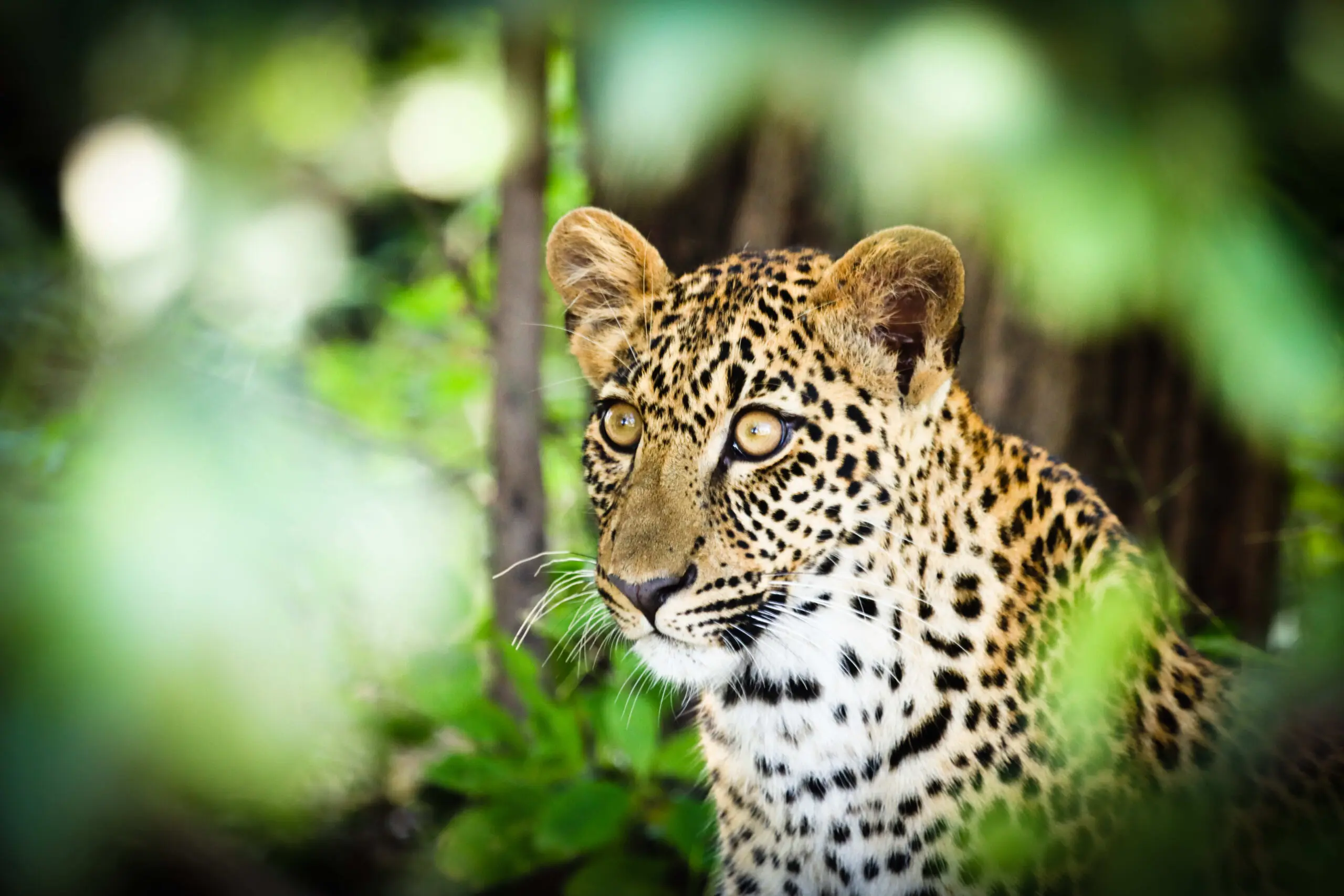
Julie Bryden and some of of her wild-tanned leather. Images by Kelly-Mae Wilkinson.
I was celebrating my 40th birthday with a small group of friends on an unsupported, back-to-basics trail — no tents, no ablutions, no cellphones, and just what you can carry — through the Greater Kruger National Park.
I was here for them, for myself, and for the wilderness. But I was also here for our guide, Julie. My woman of the wild.
My admiration for Julie dates more than a decade back when she was guiding another primitive trail through the vast expanses of the Mphongolo area in the Kruger National Park. Seemingly always tuned in to everything ancient and real, her tracking and bush skills were of another level — or another intensity- than I had and have ever come across. She was at times kudu cow, leopard, or firefinch. Nature in its human form.
The make-your-own-bag sets were an unexpected gift. The leather was cut to a simple pattern for us to sew together before we hiked on. “When was the last time this wilderness heard the sound of a natural awl piercing leather?” she asked, with a sense of genuine wonder.


Nobody replied. We sewed as we’d walked: rhythmically, with concentration, a little uncertain. We’d spent the morning unsuccessfully trying to find what had alarmed a Kudu herd — most likely a leopard. It didn’t feel like a failure, though. It felt like adventure, possibility, a gift waiting to be unwrapped.
10 years since I met her, Julie has just attained the coveted senior dangerous game guiding qualification in an assessment by the best guiding mentors in the world, including FGASA Scouts Adriaan Louw and Colin Patrick. “It’s no longer just an old boys club,” she quipped, vastly underplaying her achievement’s timely and symbolic value.
Have there been specific struggles in her career because she is a woman? After all, statistically, most rangers and trail guides are men. I asked the question not to diminish Julie but to understand if her achievements represent a crack in the shell of a chauvinist culture. “It was just me doing something that I’ve always done and sharing it with men I’ve walked a long path with and who have been role models and incredible mentors to me,” she said.
Julie has always been a student of the wild, starting her career in Nature Conservation, Wildlife Management, and Trails Guiding within the Greater Kruger National Park in 2002. This is despite fearing the bush when her parents — vegetable farmers from KwaZulu Natal — took them on annual holidays to Kruger. “I would always make my little sister sleep in the bed closest to the fence because I thought I would get eaten.”
Nonetheless, she was drawn to Kruger. This was the drive and motivation for her to graduate, one of nine women in a class of 40, Cum Laude with a National Diploma and BTech: Nature Conservation: the top students got to choose their placements. She spent almost every day between 2002 and 2007 tracking and monitoring buffalo for Kruger’s Bovine Tuberculosis Monitoring Program. She also completed advanced field ranger training (the only woman in a class of 57) and is an accredited National Assessor for CATHSETA and FGASA in the fields of both Nature Conservation and Nature Site Guiding.
As much as Julie loved her early years in the park working on research projects and adrenalin-filled game capture operations — moving black rhino, disease-free buffalo, and elephants — the “glossy cover page stuff” lost its appeal when she experienced a wilderness trail. It made something in her go still. And it set something in her free.
“That’s when the real learning started,” she said. Now, the wilderness is her true home, which she shares with her husband and her beloved boys. “I need wilderness to feed my soul. It has healed me over and over,” she said with a deep-rooted certainty.
What has she needed to heal from? I approached the question tentatively, curious but not wanting to pry. Her response was candour. “When I became a mother, I lost my own identity. On a wilderness trail in Rwanda, I realized how much of a shadow of myself I had become. When I set off on that trail, I was running away from my boys. Now when I go on trail, I look forward to coming home to them.”

Julie’s day job in Kruger was to support rangers in the field, which she handled with the same calm authority as she would a charging buffalo bull. She’s never complacent, though. “I’m always afraid of making a mistake that will cost someone their life.”
Her honesty is like her empathy — a kind of superpower she doesn’t know she has — but the two qualities make her an exceptional woman, mother, wife, and guide.
Bushcraft has helped her feel her way deeper into her environment and her own identity. “It’s like my synapses have rewired themselves to continuously find solutions to any problem, using what’s already in nature, in the form you need,” she explained. Instead of carving an awl for leather work, she uses a spine from a sicklebush because it‘s got the point and an excellent grip. “It’s not trying to justify the sicklewood’s existence because it now has a function to me. That doesn’t make it even more of a sicklebush than it was before. It’s about creating more of a connection with it,” she said.
Where mere mortals like you and I use our Instagram accounts for self-promotion or curated ideals of happiness, Julie posts detailed photos of “buckskin stitched with sinew with a fish skin thong made from a simple two-ply twist of some left-over scraps of fish skin leather” or “home tanned impala, bark and brain tanned leather,” or a “grewia bark utility basket,” or a pot made of “primitive wild clay with milk glaze.”


To learn, she relies on experimentation, her bush knowledge, and the occasional YouTube video. These are usually filmed by like-minded people in other parts of the world, so she searches for local materials to serve the same purpose. Sharing via Instagram is her way of saying thank you to the community, which has helped her develop her skills.
Back in the Mohlabetsi riverbed, our group of women had moved closer together. Our stitches had become more confident. We chatted about where the leopard might have been. About the little bones of a mouse that we’d seen in the pellet of an owl. About the martial eagle we’d spotted. About how close the hyena had really been the night before. About how Julie had taken our fear and held it like a baby bird.
“My favourite part of the trail is watching how you come together in community as women,” said Julie. We would have followed her anywhere.
The next day, in between walks, we sat and sewed again. As our bags took shape, Julie explained how she’d prepared the rawhide, first scraping it clean, then removing the hair with the alkaline ash of a cooking fire, then soaking it in a tanning solution she prepared using black wattle bark collected from her family farm in KwaZulu Natal. She tended to the hide for weeks while it transformed. “I burst into tears when I had the sheepskin softening and melting in my hands like it was supposed to. There was a feeling inside me that I‘d never had before,” she said.
The search for methods of preserving hides started in the early Stone Age when our ancestors rubbed fatty substances into rawhides. Around five thousand years later, the people of Egypt and Mesopotamia are said to have invented the slow process that uses tannins occurring naturally in the bark and leaves of plants. It’s a skill few still practice. Julie experiments with many natural plant tannins. “And I use a different blender when working with brain. My boys know that’s not the one we use for smoothies,” she said.
She showed us a selection of differently treated hides. There was thin, transparent parchment, like ancient scholars would have written on. When the same skin is soaked in a solution made from the leaves of the velvet bushwillow, it becomes pliant and richly coloured leather. And when cured with brain and smoke — because the smoke contains phenol, an active tanning ingredient — it transforms into soft cream suede.

I had hated sewing as a child. Now, it didn’t seem so bad — less a function of demure womanhood, more of a badass survival skill. When our ancestors learned how to wrap pieces of animal skin around their feet to protect them from stones and thorns, they could walk faster and farther. And when they learned to cover their bodies with hides, they were protected from the elements.
Later, it seemed more than that even: a doorway into a new relationship with the landscape. One of reciprocity and respect. It wasn’t just making leather. It was a way of being in the world. An abandoned blue waxbill nest and dry mounds of elephant dung were gifts for fire-making. The flexible limbs of the sandpaper raisin bush could be woven into a basket. The mud wallows where we’d seen some buffalo tracks were also a source of clay for pots. Everything we needed to survive was in our immediate environment. It was wild and beautiful.

“Sometimes, I feel overwhelmingly sad. We’re losing knowledge and wilderness all the time. We used to live out here comfortably. Now we’re scared to walk around,” Julie said. That evening, she showed us how to dig in holes the elephants had made, and we bathed, led by our Diana, our goddess of the wild.
After the trail, I spent a lot of time thinking how I’d find the words to communicate the value of Julie’s deep direct love for the natural world. What her many gifts over ten years have meant to me. What they mean to all of us. And what had we stitched together out there in the wild.
Julie now lives in Zambia. An edited portion of this story appeared in Getaway Magazine.