The Sabi Sands Game Reserve has a reputation for delivering great leopard sightings. A study by big-cat conservation and research NGO Panthera looks at the factors that make this reserve one of the world’s last true havens for these spotted cats.
He was a hint of dappled movement in the thick riverine undergrowth. I felt the adrenaline pulse through my veins as I willed my eyes to penetrate the thick vegetation the large male leopard was navigating. We’d finally found him — the challenge was not to lose him to the shadows on the far bank. With a rising river between us and him, time was tight and we had to make a call — try to cross, or watch him disappear.
“Let’s do it,” said guide, Andre McDonald (known as Mac), executing a bumpy turn on the muddied track that runs along the river. Having only just found the leopard we’d been searching for all morning, driving away from him seemed counter-intuitive, but the waters were rising fast after the first rains of the season had fallen the previous night. “We’ll circle back, cross before the river gets any higher, and intercept him,” said McDonald, confidently anticipating the big cat’s movements with an instinct honed over decades working as a guide at The Dulini Collection of Lodges in the Sabi Sands Game Reserve.


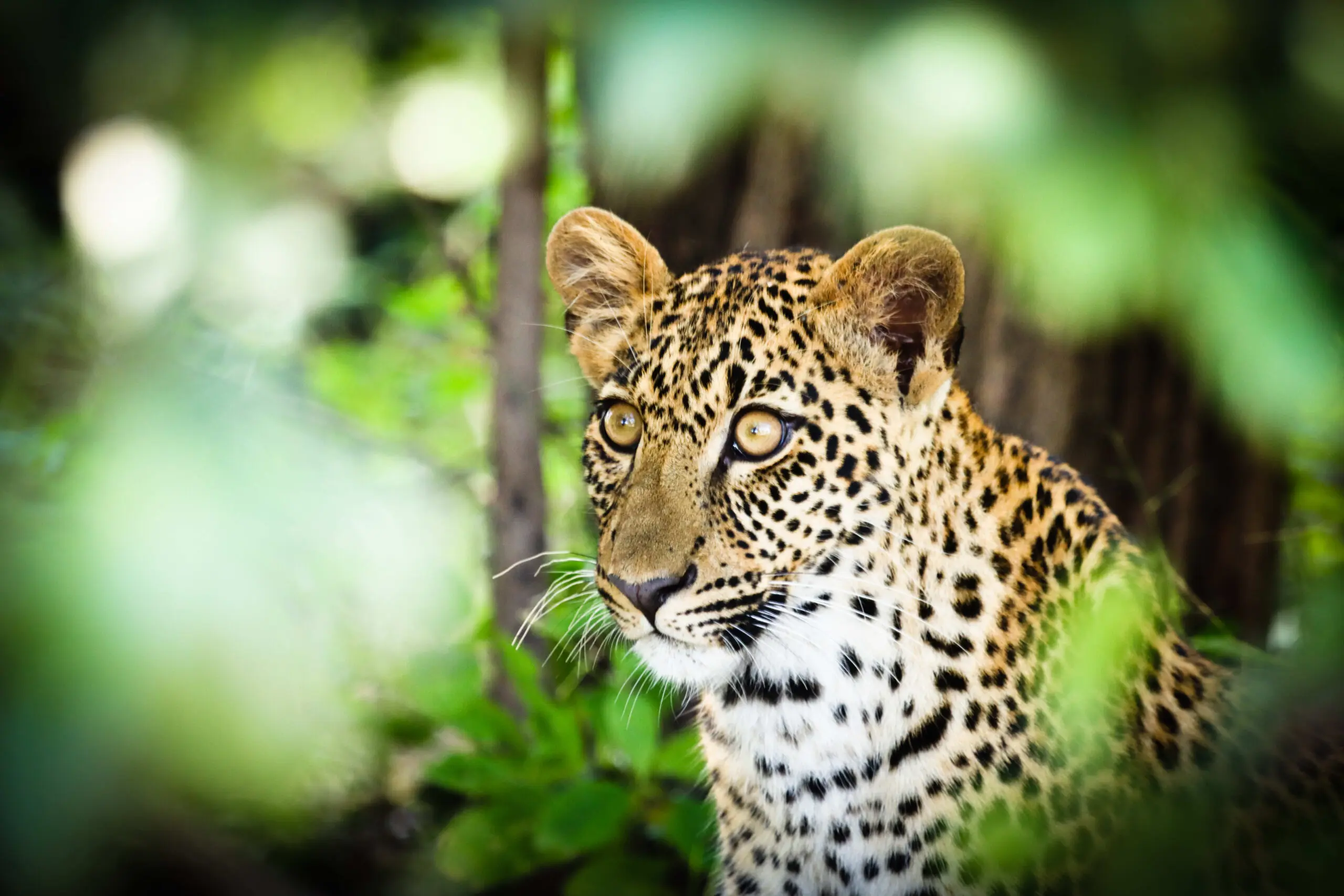
1. On safari in with Dulini Lodge in South Africa’s Sabi Sands. 2. Guide Andre McDonald. 3. Ravenscourt. All pics © Dianne Tipping-Woods, taken at Dulini Lodge in the Sabi Sands, South Africa.
A 2019 study by Panthera, the global wild cat conservation organisation, supported by Singita and various land owners, confirms what travellers to Sabi Sands Game Reserve have long suspected. This 625 square kilometre, privately managed reserve in South Africa’s Mpumalanga province is one of the best places in Africa to see leopards, with the data suggesting a population estimate of 12 individual leopards per 100 square kilometres.
“At any given time, there likely between 70–90 independent leopards (excluding cubs) using the reserve,” says Dr. Guy Balme Conservation Science Deputy Executive Director for Panthera. This population estimate is likely close to the upper limits attainable by the species, thanks to high levels of protection for leopards, as well as optimal habitat in terms of prey availability and cover for hunting. The reserve’s annual management budget of USD 4000 per square kilometre per annum — generated mainly by photographic tourism from its 20 privately owned properties — well exceeds estimates for the costs of successfully conserving wild felid populations, which experts say range from about USD 930 to USD 2000 per square kilometre, per year.
The leopard we’re looking for is one of 22 (8 adult females, 6 adult males, 3 subadult females, 5 sub adult males) that were captured in Panthera’s camera trap survey on a portion of the reserve to assess “the density, structure and spatio-temporal patterns of a leopard population largely unaffected by anthropogenic mortality.”
This is because as well as being abundant and relaxed around people, this leopard population is also one of the only ones in the world that is not affected by human induced threats or conflict. Carnivores are particularly vulnerable as they compete with, and are often killed by humans, but in 40 years in the Sabi Sands Game Reserve, just 2% of leopard deaths have been due to humans. This is significantly lower than the 15% of deaths attributed to humans in other protected leopard populations and 95% of deaths on unprotected populations; where leopards are shot, trapped, poisoned, snared and run over.


Meanwhile, a couple of hundred meters upstream where the river bank isn’t so steep, McDonald angled the open game drive vehicle for the crossing. “Ready,” he asked? “Hold on…” Many a ranger has become the victim of sands that have shifted or softened unpredictably after the rain, but as we powered across, water churning, I could already see he had timed it perfectly. Not only were we going to make it through without incident, but there, emerging from a cluster of magic gwarrie, was our prize; a large male leopard known as Ravenscourt. He flopped and rolled in the damp sand, before settling on his stomach, looking at us with intense, golden eyes.
In a reserve full of celebrity leopards Ravenscourt’s story still stands out. His mother died when he was 10 months old, falling out of a tree and breaking her back while defending him from another leopard. Most leopard cubs that young wouldn’t survive in the wild, but he did, and is growing in stature and prowess with each week that passes. “He thinks he’s invincible,” said McDonald as the powerful cat stretched and resumed patrolling his rain-washed territory, pausing to sniff and scent mark, with us following slowly behind in the vehicle.
Despite the leopards of the Sabi Sands being very well-known — there are blogs, websites, safaris, documentaries and TV shows dedicated to its individual leopards, with amateurs and professionals tracking their lineage and histories — Panthera’s study provides the first robust estimate of leopard density in the reserve.
“It’s been fascinating to hear about the outcomes Panthera’s work. Leopards are popping up that we haven’t seen — there are still the shy, secret and unhabituated ones — and then there are ones we’ve followed since birth,” said McDonald as we watched a languorous Ravenscourt watch a pair of Egyptian geese down at the water’s edge.
Sightings like this should never be taken for granted. Globally, leopards have undergone a marked reduction in numbers and range, yet the species was until recently, assumed to warrant little conservation concern, notes Balme. In fact, only 17% of extant leopard range is protected and almost all leopard populations surveyed to date are affected by humans. This means their management has largely been guided by anecdote and experience, rather than scientific evidence. That’s why this study by Panthera is so important; it can inform conservation targets, help assess the health of other leopard populations and critically, help anticipate the outcomes of population recovery attempts by providing unique insight into “a naturally functioning carnivore population at its ecological carrying capacity,” said Balme.
It’s also why the Sabi Sands Game Reserve is such a haven for leopards. Open to the Kruger National Park on its eastern and southern boundaries since 1993, with a practically impenetrable fence to the west and north, leopards here range freely over a landscape that’s almost the size of Belgium. Although people and leopards frequently encounter each other in the reserve, leopards rarely stray outside of its boundaries and are therefore protected from ‘edge effects’. These are threats that leopards face when they encounter people or habitats outside of protected areas; like snares, hunting, roadkills and other human-induced dangers. This is unusual for leopards. As a species, they are prone to stray, but the Sabi Sands fence makes this almost impossible for them; it’s hard to dig under, electrified, three meters high and free of trees that would aid an escaping leopard.


As Panthera’s survey shows, Ravenscourt is just one leopard that vistors to the reserve can see on safari. Using rigorous statistical analysis on the data gathered from 74 v6 Panthera digital camera traps at 37 unbaited stations, the survey covered 91 square kilometres; more than double the mean home range of adult male leopards in the reserve, for a period of about 6 weeks. Stations were placed about 1.3 km apart, on roads, drainage lines and animal paths.
The fact that these leopards have been studied over decades helped the researchers select the sites, and the cameras have also captured a huge variety of other wildlife. A total of 29 419 photos were taken recording 43 other species. “Don’t even get me started on the birds here,” says McDonald, whose personal list is edging towards the reserve’s total of 350 plus bird species. Passionate about the ecosystem in its entirety, McDonald admits leopards do have special place in his heart; “we live with them, afterall” he says.
The big cats treat the lodges as they do any part of their range, popping up on decks, sleeping on outdoor couches and moving between rooms with little to no concern for people or structures, sometimes treating lodges as an extension of their territories. “We have an insurance claim in of about R100 000 for ‘leopard damage’. They do sometimes chew the outdoor furniture,” said Dulini’s co-owner Sue Garratt, as she welcomed me to the new refurbished lodge the day before. With its signature tones of gold, bronze and charcoal, Dulini’s exclusive Leadwood Lodge is set amid the acacias, terminalias and combretums that are considered prime leopard habitat, and guests often spot them from their suites.
Later on game drive, we found sibling cubs playing under a marula tree where their mother, the Boulder’s female, had cached a kill. They looked like large kittens, rolling around in the grass.
“Never make them into house cats though. They deserve more than that. No matter how chilled they seem, they are wild and free and we should never impose our own attributes to their behaviors, or get complacent in their presence,” cautioned McDonald.
Suddenly, the playing stopped. The female pivoted into the tree, while the male made himself invisible in the grass. A hyena was approaching. While humans don’t kill leopards in the Sabi Sands Game Reserve, hyenas, lions or other leopards do. About 70% of baby leopards don’t make it to adulthood, “but the father is Ravenscourt and with him being so dominant, so long as the female stays in his territory, they have a good chance,” said McDonald while we tensely watched the hyena investigate the base of the tree, before moving on with a scrap from the carcass in its jaws.
As well as killing leopard cubs, data suggests that 10% of leopard kills are lost to hyenas. This is where leopards ability to cache their kills in a valuable adaptation. In this survey, the frequency and times that hyenas were recorded after leopard sightings could even suggest the hyenas track them in the hopes of an easy meal…
“That’s what’s really incredible; we know these leopards so well, and yet there is still so much to learn about them. And the research doesn’t prepare you for this; the thrill of watching them behave the way they should, in their natural habitat. It never gets old,” said McDonald, as we reluctantly drove away from the cubs. The sky was full of purple thunder and lightning strikes and as we got back to the lodge, the rain began to fall.


Where to stay
The Dulini Collection hosted me and offers guests the choice of three, exclusive luxury lodges in the Sabi Sands Game Reserve. Game drives traverse an area of 100 square kilometres and strict vehicle limits at sightings ensure the exclusivity of your game viewing experience. Off-road driving enables the best possible view of any exceptional sighting and rangers are constantly in touch with each other to keep track of animal movements.
There are also a number of other high-end lodges in the Sabi Sands.
A version of this story first appeared in Responsible Traveler.