Listen to this article:
Narrated by author Dianne Tipping-Woods
How Anton Mzimba was murdered in his own home
This story is my personal acknowledgement of what Anton carried for all of us who care about wildlife – and people. The responsibility, conflict, baggage, expectation, complexity, and hope inherent to conserving biodiversity in areas with deeply conflicting ideologies, values, and basic needs that just aren’t met.
Anton mattered most of all to his family, the family that lost the dad, husband, and brother. He was not just a hero. The story left me with a lot of doubt about myself and my work, but what’s not in doubt is that Anton mattered – and I think stories like this matter.
The war against rhino poaching knows many bloody fronts, from bustling harbor towns in Asia to African savannahs where the endangered animals are killed for their horns. The murder of revered South African head ranger Anton Mzimba at his own home in 2022 is an ominous sign of battle lines redrawn.
Anton Mzimba’s bakkie still had the paint he’d bought earlier in the back. He’d been to the hardware store and had promised one of his wives, Agnes, that he would spend the next day working on the house he was building for her. On leave after a 21-day shift in the Timbavati Private Nature Reserve, where he was head of ranger services, Anton was looking forward to his few days at home more than usual.
His job was always stressful as a high-profile ranger protecting wildlife-under-siege like rhinos and pangolins. Still, the last months had been even more so. Colleagues confirm he’d been receiving death threats, messages passed on by acquaintances, and notes promising to kill him. Not a man to be intimidated, he opened a docket with the Hoedspruit police. In the week before his death, he’d had dinner with a donor to the ranger corps, where he’d said he believed the threat against him had lessened. That he could breathe easier.
The sophisticated intelligence networks he was part of were seldom wrong. That’s how it was sometimes in criminal circles; a better offer comes along, or plans change. You could never rule out the duplicity of an informant or the impulse of a corrupt colleague, but nor, Anton believed, could you live your entire life in fear. He believed the threat had been contained – at least for now.
Back home, his car’s engine was making a noise he didn’t like. The hood was open while he looked for the problem, but it was getting dark. His food was nearly ready – his first home-cooked meal of pap (maize porridge) and stew after nearly a month away. We’ll never know if Anton was suspicious of the white VW polo that pulled up at his quiet home. In the gathering darkness, a man with a plastic bottle asked for water for his overheating car. Ever helpful, Anton called for his son to fetch it. Some words were exchanged. A shot rang out, and then another. His wife Grace screamed. The bullet that punctured her abdomen just missed the three-year old clinging to her.
Anton’s fatal shooting on 26 July was not an isolated incident. The Game Rangers Association of Africa said Mzimba was one of 295 rangers killed on the continent since 2011. In South Africa, ranger deaths have been relatively rare, but emboldened syndicates are increasingly brazen with seemingly little to fear from law enforcement.
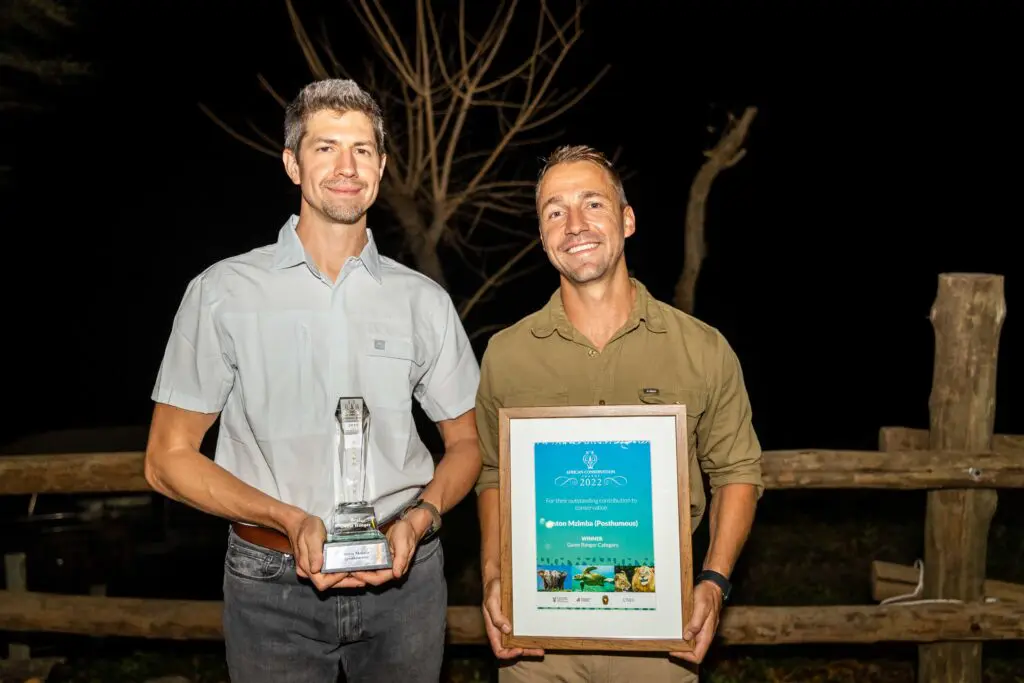
John Jurko (L) and Matt Lindenberg (R) of Global Conservation Corps accept the Africa Conservation Award 2022 for Best Game Ranger, awarded posthumously to Anton Mzimba. © Stew Nolan
Ranger Life
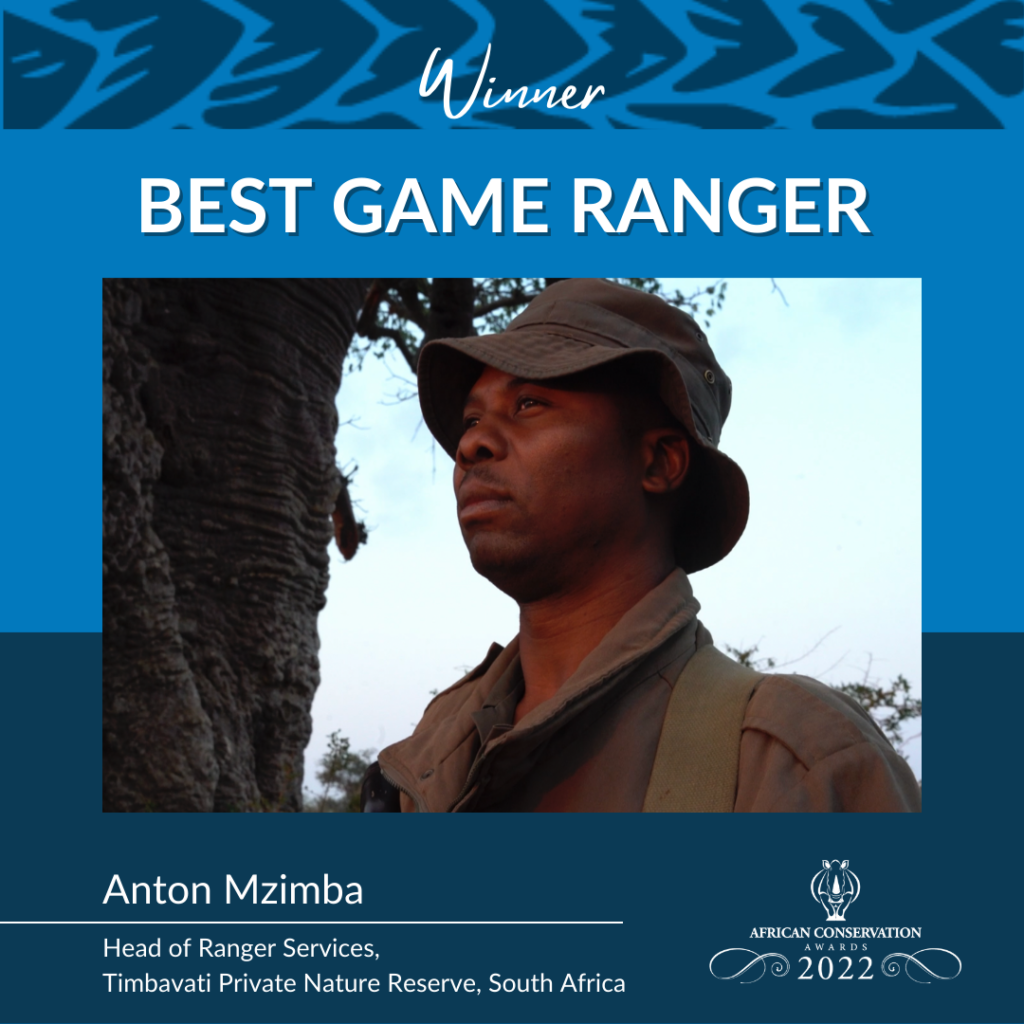
Anton had worked as a ranger for 25 years. At the 2016 Rhino Conservation Awards, he was given the Best Field Ranger award. At the 2022 Africa Conservation Awards, he was posthumously named Best Game Ranger. He was also a technical adviser for the US-based Global Conservation Corps, advocating for rangers, children, the community, and wildlife. Through this, he became close friends with John Jurko and Matt Lindenberg, who accepted the Award in his honour. They had been working with him for years on the movie Rhino Man – a film that follows courageous field rangers who risk their lives every day to protect South Africa’s rhinos from being poached to extinction.
While rangers face daily dangers from wildlife and criminals at work, threats at home are often less immediate than an adrenaline-filled poacher or a charge from an old buffalo bull. Rangers often come from the same communities where poaching may be more entrenched than conservation and may pay better. They must navigate sometimes divided loyalties, the pressure of a high-stakes job, and long periods away from home. Strangers often laud them as heroes, while those they know and live with may wish them harm. “The complexity of the landscape around Greater Kruger’s reserves is mindboggling,” said Craig Hay, who works on ranger wellbeing for WWF South Africa. He references the historical injustices, extreme levels of inequality, and people struggling to access basic rights. “Criminal elements like wildlife crime syndicates are embedding themselves in this context. Rangers are in the hot seat, recruited from communities where syndicates operate. That creates a terrible dilemma and tension for some.”
Unwavering
Anton, though, by all accounts, was unwavering. “He was incorruptible,” said ranger trainer and friend Ruben de Kock. Anton loved rhinos as a symbol of the wild. He saw the population’s demise as proof of our damaged relationship with nature. Hunted and then poached almost to extinction, more than half of Africa’s remaining white rhinos live in the greater Kruger landscape, with about 300 of the world’s remaining black rhinos. South Africa’s Department of Forestry, Fisheries, and the Environment released rhino poaching figures for the country for the year of Anton’s death: 259 rhinos were poached in South Africa in the first six months of 2022, with 82 poached in Kruger National Park. The Timbavati Reserve, where Anton worked, is part of a collection of Private Nature Reserves that form the Western edge of the vast Greater Kruger landscape, which stretches East into Mozambique and North into Zimbabwe as part of the Greater Limpopo Transfrontier Conservation landscape.
Back in their home village of Edinburgh, Anton’s two wives, Grace and Agnes, were in heavy mourning. Wrapped up in rough printed blankets as though freezing, they were gathered in a dark room despite the warm day. They didn’t talk amongst each other but could hear the noise and bustle of their friends and community members attending Anton’s wake. Grace’s bullet wound was healing – she showed me – but her eyes were vacant. Agnes nursed Anton’s little girl who was not yet one. Saviour, Anton’s firstborn, wore a smart navy suit and looked older than his then21 years. “They’re all having nightmares. The little ones are screaming in their sleep,” he said.
Anton was already in the ground behind his unfinished house. He had been buried in the opaque light of a misty dawn by his fellow rangers, some of whom discharged their weapons in his honour. Many wore bullet proof vests. The rest of the morning was spent remembering him. His family, friends, and fellow rangers spoke about him as a dad. A hero. A leader in his community. The Rhino Man. The phrase was repeated often. Proudly. His extended family served the mourners pap, chicken, beetroot and relish. My husband and I, the only white attendees, aside from Linda Tucker from the Global White Lion Trust, were treated with a reverence we hadn’t earned and didn’t deserve. But I listened to everyone’s stories and conversations about this man I had only met once.
An Unusual Bond
Meanwhile, another friend mourned Anton on his feet in the wilds of their beloved reserve.
Timbavati Warden Edwin Pierce had given the field rangers leave to attend the burial in Edinburgh. The reserve had already honoured Anton with a moving memorial, but burial rights needed to be observed. Edwin patrolled in their stead, walking paths Anton had trod for over 25 years.
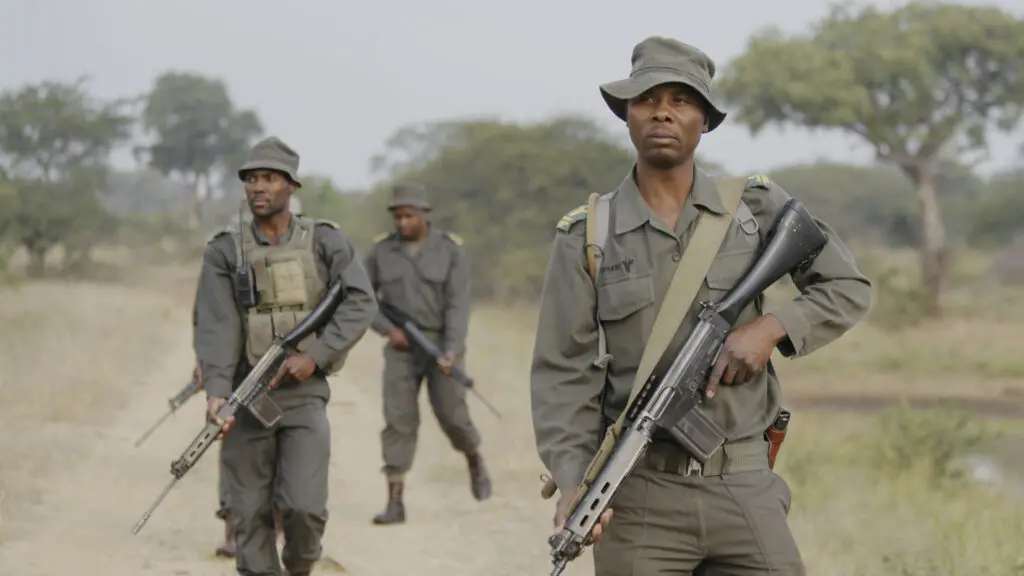
“The first anti-poaching patrol I ever did was with Anton. I have lost a friend, a brother, someone I could divulge anything with. I have had a few nights where I can’t stop the tears, but we have moved forward and processed what we need to. Everything we are doing in this reserve, Anton’s legacy guides us,” said Edwin. Rangers work in 21-day cycles, and their duties include looking for breaches in the fence, suspicious tracks, and signs of activity that shouldn’t be there. Rangers’ jobs have changed drastically in the last 15 years. They now include drilling, shooting practice, tactical operations training, and counterintelligence, with efforts scaled up to counter increasingly sophisticated and deadly poaching operations.
Intense feeling is not uncommon between rangers who spend time deep in the bushveld, where they are wholly reliant upon each other and under constant threat. But Anton and Edwin’s deeply held friendship was somewhat unusual in the conservation community, where long-running concerns about discrimination, colonial legacy, privilege, and power dynamics linger, even as progressive reserves drive change. Edwin said he and Anton, the most senior black person in the Timbavati management structure, were forging a new, more inclusive path. “Everyone wanted to be like Anton, including me,” he said, speaking of Anton’s advocacy within the reserve and the sector for better salaries, improved living conditions, and the best ranger equipment. Anton was also a passionate about improving relationships with communities.
Some editors questioned the “uncommon bond” between Edwin and Anton that I portray. Was I romanticizing the relationship to tell a better story? Anton wasn’t there to ask, I said. Edwin was. And I believe he was sincere. He was hurt and angry and honest. He didn’t want to speak with me at first because he really doesn’t care about publicity or sensation. And if there was another opinion on their relationship, I didn’t hear it. Edwin now works closely with Orlat Ndlovu, a close friend and colleague of Anton and the new Head of Ranger Services at the Timbavati Private Nature Reserve. “Losing Anton was like half of my body is now missing. He was my brother,” Orlat said.
Another comment was that I skirt the realities of what makes such a bond uncommon: if Mzimba — now “the most senior black person in Timbavati’s management structure” — in fact took Warden Pierce on his first anti-poaching patrol 25 years ago, how have their careers and lives progressed in parallel since then, and how have their paths diverged? Do the risks and rewards faced by each of these career rangers – Anton and Edwin – differ? They asked how well Edwin gets on with other black rangers. And they asked how this fraternal feeling squares with later descriptions of hostility and threats by rangers known to Mzimba?
These are all good questions. And ones that, as a white woman living in the affluent area adjacent to reserves where rangers work, far from the communities where they live, I can ask. But I’m not likely to ever ‘know’ the answers without living the reality. The best I can do is be honest about the conversations I had after Anton’s death with his wives, brother, niece, fellow rangers, and other reserve staff, his friends and Edwin. These lead me to believe that Anton would have tackled the questions head-on. I am told he had a sophisticated understanding of the dynamics in his community, his reserve, and globally. And that he understood his role in disrupting and perpetuating these dynamics. He would have spoken candidly about inequality, poverty, and persistent racism. And he would have spoken about integrity, loyalty, trust and the deepest betrayal.
The Man And The Myth
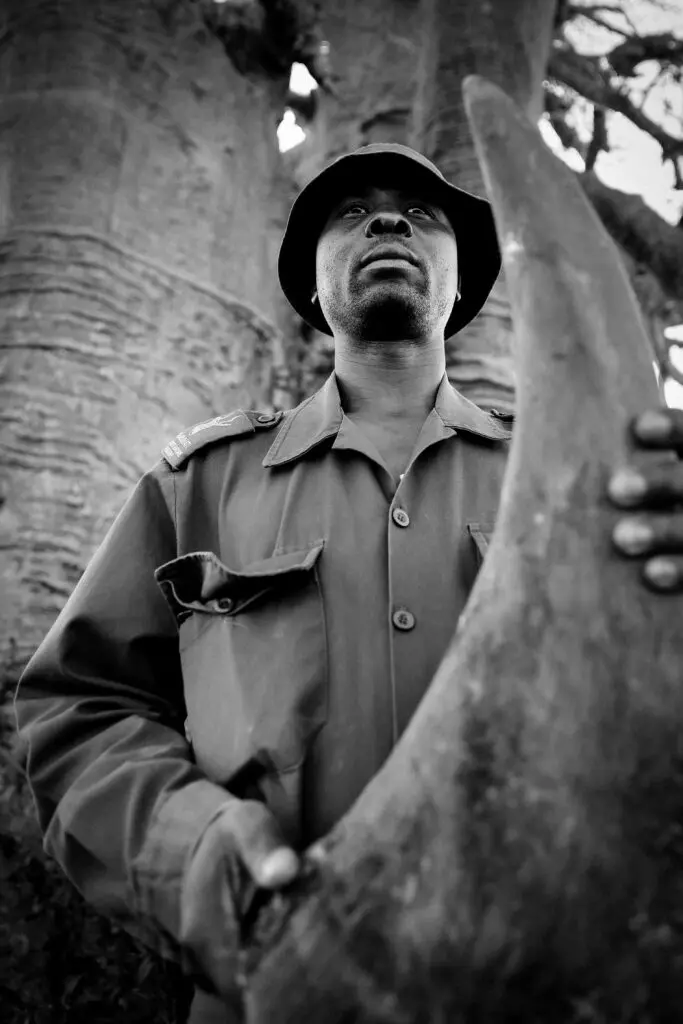
People who knew him speak about Anton almost mythically – “the most honest man I have ever met” and “the epitome of integrity.” He was someone, friends say, who treated everyone the same, whether his neighbour or the Prince of Wales. He was also fanatical about conservation and very aware of the risks of death. “He felt it was a calling from God,” said Grace. At home, he didn’t dwell on the dangers of the job, instead telling them stories about the animals he saw. “He wanted to protect us at all times,” she said. They believed Edinburgh was well away from the dangers of the wild, where a poacher would as soon shoot as look at a ranger. “He always wanted to make up for the time he was away. It gave us such dignity to go out into the community as his wives,” said Grace. Since his murder, they have contemplated the question: what if he was not a ranger? – “But we only say that because something bad happened to him. He won awards. He was the best man for his job,” said Grace. I asked if she was angry? Yes, she said. At his killer.
Two of Anton’s sons still want to be rangers, and a third wants to be a soldier. Grace and Agnes smile when they talk about nine-year-old Grant. “He marches and makes weapons with branches. He hides in the trees, doing what a ranger would do. He loves it from the bottom of his heart and said, ‘I want to do the job that daddy did.’ I want people to know he was the best father and husband and fought for his community,” said Agnes. Guns, hiding and shooting are little boys’ games everywhere to some extent. Will there be a time when kids can role-play other aspects of a ranger’s work?
Grace said God’s will is painful because Anton was a hero who stood for what was right. “Why did they come here and traumatize us and make us see something we can never forget? With his life, they took away our peaceful and happy home.”
That he was killed at home, in front of his family, has made his death more shocking. Multiple sources have confirmed Anton was being threatened by rangers who had been revealing rhino locations to poachers for a backhander. In a three-month period from February to April 2022, six Timbavati rhinos were shot and killed by poachers. “Every carcass you find in a reserve can be linked to somebody providing information. You don’t simply bump into a rhino. We did dismiss some field rangers. We followed the right process. Those field rangers had incredible anger and hate, and that’s when the threats to Anton started,” said Edwin.
While it is possible that those who tried to intimidate Anton weren’t responsible for his death, why, asks Edwin, wasn’t the intimidation docket picked up? A month after the murder, there was no new information. More than Anton’s murder, this puts doubt in the minds of rangers because if somebody like Anton was murdered and no one is held accountable, what about us?” Sources at the reserve, in the community, and in law enforcement confirm that they think the police have enough information for an arrest. The police did not respond to requests for information. “There needs to be more focus on wildlife crimes as a high-priority crime in South Africa. We owe that to Anton,” said Edwin.
At Anton’s funeral, his niece and fellow ranger Leitah said, “Anton knew who was threatening him. We want to mourn. And then we want justice.” Sergeant Patience* has worked as a field ranger in the Kruger National Park since 1992, and he knew Anton from the beginning of his career. He said: “Give us guns at home. If he’d had a gun, maybe he would have had a chance.” His name was changed to protect his identity. Representing traditional leadership structures, secretary to the Edinburgh headman Jackie Mathebula said: “There are many cases where people take the law into their own hands. Let’s hope there is an arrest soon.” Two years later, there is still no arrest. The Hawks, the special police unit set up to investigate organised crime and corruption, has taken over the running of the case from the local force.
Safer Rangers?
Anton’s death has also shaken park management and anti-poaching organizations. Much focus is put on ranger safety at work – boots, vests, and the rest – but rangers always go home. “There, we’ve got very little control of what happens,” said Edwin. They’re now doing a risk assessment to examine each field ranger’s safety independently. “As far as possible, we want to offer the same precautions we implement within the reserve to the ranger outside. At the same time, you can’t isolate them from their community,” said Edwin.
“When we started this intense running battle 15 years ago if we put the same effort into the socioeconomic side of rhino poaching as we did to the militaristic approach, we would be in a different space completely,” said Sharon Hausmann, CEO of Greater Kruger Environmental Protection Foundation. This non-profit assists with protecting wildlife and combatting environmental crime. While she regrets enforcement over socioeconomic development, how much has that changed in practice now? The reality is not enough.
Sharon remains the most stalwart and fierce advocate for rangers and rhinos. Still, she said, knowing community members’ challenges, “I almost felt guilty that we are obsessed with rhino crime. These people have other things to worry about rape, theft and murder, and little recourse to the law.” She recalls a meeting on crime in a community adjacent to Kruger. Someone said the reserves are lucky because they have their armies protecting them, while the community has nothing. “And someone else said it’s better if the people poaching are successful because they leave the community alone. For years now, at every meeting with the government, I say we are sitting on a time bomb. Real issues in the community are not being resolved. They are not being listened to by government and local authorities.”
Anton spoke with great insight and sensitivity to Sharon and others about the community’s plight and their importance in conservation landscapes. In an interview with the Global Conservation Corps, he said, “The origin of the problem is similar across many parts of Africa. People were displaced from their land when the protected areas were formed. The situation was made worse by the fact that if they wanted to access the protected areas, they had to pay. The local people also see foreign tourists enjoying the protected areas, while the communities are not even allowed to benefit from the game meat. They are considered heroes in the communities when they illegally hunt and bring meat back. We need to find a way of sharing natural resources. We must give people ownership rights to the land and share fairly. When there are new developments for tourism, the people need to be able to have their say and be heard.”
Shifting power to those who historically haven’t had it takes time, though. Meanwhile, criminal masterminds in Asia fuel the poaching situation with their demand for rhino horn, while poverty in communities around Kruger provides an endless stream of foot soldiers. It can be hard to decline when the poachers approach people in the communities – or even rangers – to assist them. Some may be ruthless criminals, but others may be people trying to look after themselves, their families, and the community by illegal means but without ethical distress. A white minority ruled South Africa until 1994. Black people were never included in conservation-related decisions or even in discussing why protecting those areas and animals is important. Many have never been into a reserve despite living on its doorstep. There are almost no black or community-owned lodges in the Timbavati and many other private reserves, and a luxury lodge holiday is a world away from the reality of life for many in the community. One night at such a lodge can cost more than a month’s salary for a ranger.
Criminal Elements
Nonetheless, wildlife crime runs in parallel with many other crimes. Syndicates are ruthless and highly organized. “I don’t want poaching in my community. It only gets people killed,” said Penny*, a woman from a village not far from Edinburgh who is an active member of her community crime watch. Her name has been changed to protect her identity. She explains how poachers infiltrate communities, building relationships with young girls impressed by their money and young men disillusioned with unemployment – including her own grandson. Undoubtedly, she said, people “coming from the outside to kill our heritage” are aided by community members tempted by the promise of quick riches or entrapped by drugs or debt. Penny* watches for new people in her midst: the houses that go up, the cars, and the sudden flash. “It doesn’t help that these guys get arrested, and then, soon after, they are out because the syndicates involved in poaching are powerful,” she said. “Even police can be recruiters. They are all part of this.”
The Mental Battle
And while Anton was respected in his community, he still had enemies. Social anthropologist Naomi Haupt was involved in a recent ranger survey for WWF that showed that between one and two rangers in ten had faced verbal abuse or had been threatened by local community members during the previous 12-month period. Around 80% of rangers believed that community members see them as the enemy and pose a threat to them, and just under 40% of rangers felt that the community does not trust or respect them, “I think one of the most important comments ever that refer to ranger training – this came out in the survey – is that they need training that makes the field ranger know that they are valued,” she said.
Work done by WWF and other organizations to understand ranger perspectives is increasingly feeding into management discussions, and because of the relentless strain of decades of anti-poaching work, more attention is paid to rangers’ mental, emotional, and financial health. Working with WWF, the Southern African Wildlife College used some of this research to develop a leadership curriculum that teaches traditionally neglected skills: leadership, law enforcement ethics, conservation ethics, community engagement, conflict resolution, negotiation skills, use of advanced technology, and addressing corruption. “There is a deeper level of skills we need to nourish to tap into that huge leadership and human potential within the ranger corps. And they need soft places to land, so they feel they have someone to talk to when they are in a compromising position,” said Craig.
But right now, in the wake of Anton’s death, the other question on everyone’s minds is, who next? “At our first management meeting after Anton’s death, we are comparing bulletproof vests,” said Sharon. “Of course, we’re worried about the long-term ramifications. I still feel responsible because we knew about the threats. It was in our minds, but none of us believed it would happen,” she said. “We’ve lost people before in the line of our work. But this, in front of his children….” Sharon is known for her huge heart as much as her steel will. “Still, I must tell you, some people are asking, is it worth it? The cost of protecting rhinos is exorbitant, and the human cost – Anton’s life – is beyond value,” she said.
In the Timbavati, Edwin said the rangers are more resolute than ever. “It’s not that our guys didn’t take it hard. But now we’ve all got a passion for making things right. Not a single field ranger has resigned. We’ve had several requests from field rangers that left us historically to return,” said Edwin. In the years since Anton’s death, his niece Leitah, colleague Orlat, and others like Altin Gysman from the Southern Africa Wildlife College have travelled the world to share Anton’s story and continue his legacy. More rhinos have been poached. Recently, in a world first, 120 were rewilded.
At Anton’s memorial in Timbavati, ranger and pilot Steven Whitfield broadcast this message from the air as he and fellow rangers performed a sunset aerial salute for their fallen colleague. “To those responsible for our tragic loss, if you had hoped to intimidate us, you could not be more wrong. You have caused us devastating heartache, but all you have achieved is to make us more committed and determined.”
Back in Edinburgh, there was no message from the sky. Just a fresh grave and uncertainty about what lies ahead.